How we support Ukraine to safeguard reconstruction, strengthen anti-corruption systems, build defensive strength with integrity, and advance asset recovery even under wartime conditions. A snapshot of our diverse efforts.
Impact highlights
- Strengthened anti-corruption frameworks across infrastructure, transport, forestry, medical procurement and the private sector, adapted to wartime conditions.
- Produced the first joint strategic corruption risk assessment of Ukraine’s civil infrastructure recovery, in partnership with the National Agency for Corruption Prevention (NACP) and the State Audit Service.
- Provided ongoing support to Ukraine’s anti-corruption institutions at a critical juncture, amid increasing political pressure and risks to institutional independence. The programme delivered advanced training to more than 93 prosecutors, investigators and judges, with training now expanding to the Specialised Environmental Prosecutor’s Office to address environmental crime risks.
- Enabled progress on international asset recovery, including execution of six mutual legal assistance requests by Switzerland and expert support on frozen Yanukovych-era assets.
- Assessed corruption risks in 336 restoration grants worth UAH 61.8 billion, with our recommendations formally endorsed by the Ministry of Communities and Territories Development.
The situation
Anti-corruption is essential in Ukraine, especially during wartime. As Ukraine defends itself against aggression, it also plays a pivotal role in preserving the rule of law and contributing to the security and stability of Europe as a whole.
Wartime conditions create severe challenges for anti-corruption work. Yet public demand for accountability remains exceptionally strong, reflecting an unusually low tolerance for corruption even under pressure. With scarce resources and immense reconstruction needs, preventing corruption is central to Ukraine’s resilience and to its commitment to building back better.
What we did
Despite the security and financial challenges, we reinforced support to the Government of Ukraine, state-owned enterprises and civil society to strengthen transparency, oversight and enforcement. Much of this work was made possible through long-standing support from the Swiss Agency for Development and Cooperation (SDC), with additional funding from Norway, Liechtenstein, the EBRD, Swedfund, NEFCO and USAID.
Our approach combines hands-on corruption risk assessments, the development of mitigation measures and practical guidance on strengthening anti-corruption frameworks, adapted to volatile wartime conditions.
The impact
Safeguarding restoration and infrastructure
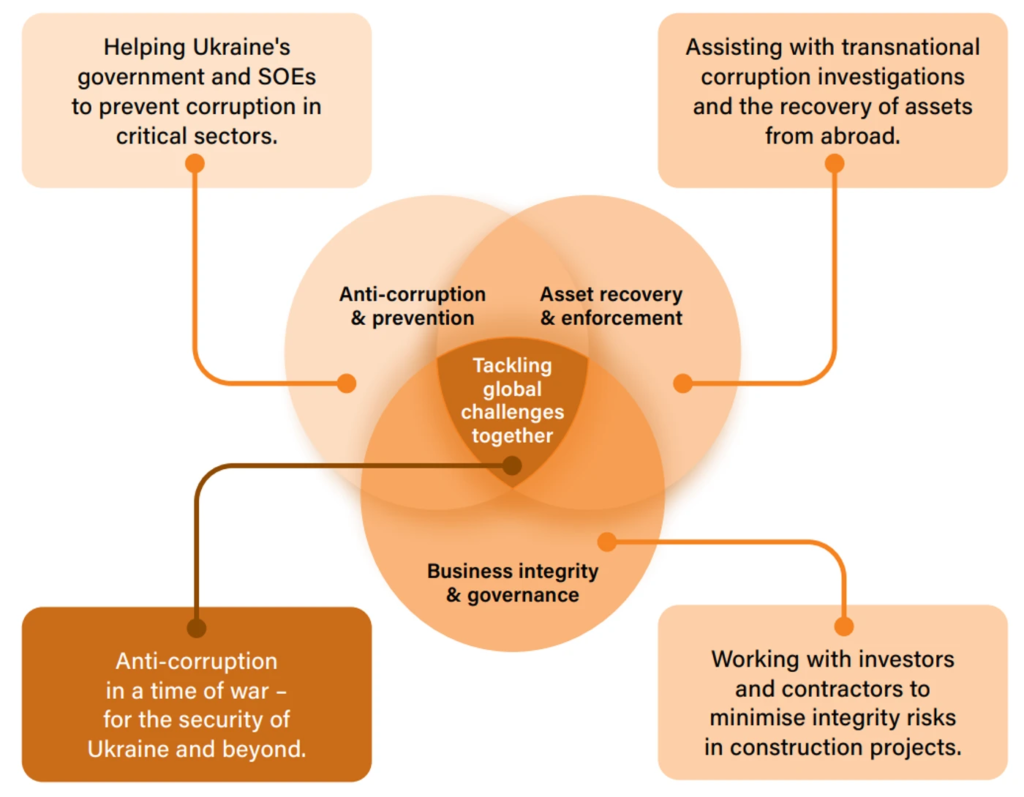
Ukraine’s restoration costs are already in the hundreds of billions of dollars – and reconstruction is ongoing even as the war rages. In 2024, working with the Ministry of Communities and Territories Development, we assessed corruption risks in 336 restoration grants worth UAH 61.8 billion. We identified regulatory weaknesses and provided detailed recommendations, which were formally endorsed by the Ministry, strengthening safeguards for future projects.
We also supported the State Agency for Restoration and Infrastructure Development to develop policies on whistleblowing, internal investigations, handling corruption reports, transparent recruitment and a Code of Ethics, complemented by targeted training and a monthly anti-corruption newsletter.
Strengthening integrity in state-owned enterprises
Ukrainian Railways (UZ), a strategically vital state-owned enterprise, faces heightened corruption risks due to its size and wartime role. Building on long-standing cooperation, in 2024 we helped adapt its corruption risk assessment methodology to wartime realities and strengthened its compliance framework with a new Anti-Corruption Programme, Code of Ethics and related policies, followed by training to support implementation. We also advised UZ on the reform of its sizable procurement system, reducing one of the long-standing corruption risks.
Protecting Ukraine’s forests from corruption
Together with the National Agency for Corruption Prevention, WWF Ukraine and the Specialised Environmental Prosecutor’s Office, we published an in-depth study on corruption risks related to forests and the timber sector. We continue to work with partners to strengthen the regulatory framework and reduce corruption risks in this sector.
In parallel, we collaborate with the state-owned enterprise Forests of Ukraine to strengthen its anti-corruption framework, helping to protect forests and support a sustainable and profitable timber trade.
Recovering assets from abroad
Building sustainable capacity in financial investigations and asset recovery is essential to Ukraine’s ability to uncover and prosecute corruption and related financial crimes and to recover vital public funds.
In 2025, five practitioners from the Specialised Anti-Corruption Prosecutor’s Office, the National Anti-Corruption Bureau of Ukraine and the High Anti-Corruption Court were certified as national trainers in financial investigations and asset recovery after completing the International Centre for Asset Recovery’s Train-the-Trainer programme. This milestone helps embed practitioner-led training across key anti-corruption institutions. As experienced investigators and prosecutors, the certified trainers are also well placed to apply and promote innovative approaches to asset recovery within their own organisations.
Alongside capacity building, ICAR experts facilitated a meeting in Switzerland between the National Anti-Corruption Bureau of Ukraine and the Swiss Federal Office of Justice, resulting in the execution of six mutual legal assistance requests. We also provided expert opinions in seven cases linked to frozen Yanukovych-era assets.